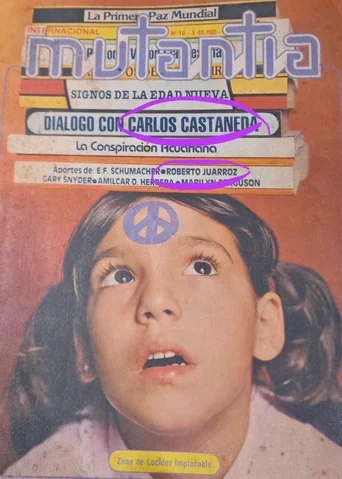
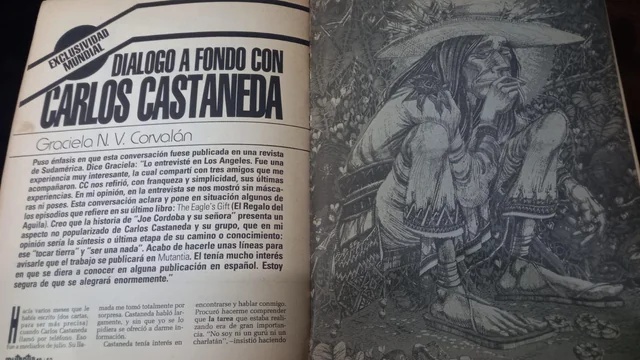
This interview with Carlos Castaneda was conducted by Graciela N. V. Corvalán and published in the Argentine magazine Mutantia in 1982.
In the text, Castaneda discusses the "Toltec teachings" of Don Juan Matus, the concept of "losing the human form," the metaphorical "Eagle" that consumes the life force of dying beings, and the practice of "recapitulation."
Below is the full translation of the text from the provided HTML:
IN-DEPTH DIALOGUE WITH CARLOS CASTANEDA
By Graciela N. V. Corvalán Mutantia Magazine (1982)
He emphasized that this conversation should be published in a South American magazine. Graciela says: "I interviewed him in Los Angeles. It was a very interesting experience, which I shared with three friends who accompanied me. Carlos Castaneda told us, with frankness and simplicity, his latest experiences. In my opinion, in the interview he showed himself without masks or poses. This conversation clarifies and situates some of the episodes he refers to in his latest book: The Eagle's Gift. I believe the story of 'Joe Córdoba and his wife' presents an un-popularized aspect of Carlos Castaneda and his group, which in my opinion would be the synthesis or final stage of his path or knowledge: that 'touching ground' and 'being a nothing.' I have just written him a few lines to let him know that the work will be published in Mutantia. He was very interested in it being made known in some Spanish-language publication. I am sure he will be enormously happy."
I had written to him several months prior (two letters, to be precise) when Carlos Castaneda called on the phone. That was in mid-July. His call took me totally by surprise. Castaneda spoke at length, and without me asking, offered to give me information.
Castaneda was interested in meeting and talking with me. He tried to make me understand that the task he was performing was of great importance. "I am neither a guru nor a charlatan," he insisted, referring to some critics and journalists. Castaneda is a serious researcher who was interested in talking about the work he is doing in Mexico and his epistemological labor. According to him, the European man cannot conceive that there is another who thinks or that there is another description of reality than his own.
Once in Los Angeles, CC called on the phone. Not finding me, he left a message and instructions about the time and place of the encounter: "Exit the Freeway at such street and turn right at such other. Then, pass four lights. There, on the left is the Church of the Immaculate, but don't let that matter to you and turn right. There, you will find the UCLA campus. Enter the parking lot. Since it's Sunday, there won't be anyone, and you can enter without problems. Usually, there are few people during weekends. So, at 4 in the afternoon; next to the guard booth." Castaneda expected us to arrive in a brown Volkswagen.
That night and the next morning I worked feverishly on my notes. I had slept little but was not tired. Around one in the afternoon, my friends and I headed for the UCLA campus. We had a journey of just over two hours. Following Castaneda’s directions, we arrived without difficulty at the UCLA parking lot guard booth. It was still about 15 minutes before 4 PM. We parked in a somewhat shaded spot.
At exactly four o'clock, I looked up and saw them coming toward the car: my friend next to a dark-skinned gentleman, slightly shorter than her. Castaneda wore blue jeans and a pale cream-colored open-collar shirt (without pockets). I got out of the car and hurried to meet them. After greetings and conventional courtesies, I asked if he would allow me to use a recorder. We had one in the car in case he permitted it. "No, it's better not to," he replied with a shrug. We headed to the car anyway to get the notes, notebooks, and books.
Loaded with books and papers, we let Castaneda guide us. He knew the way well. "Over there," he said, pointing with his hand, "there are some very nice benches."
From the beginning, Castaneda set the tone of the conversation and the topics we were to discuss. I also realized that I was not going to need all those questions I had so laboriously prepared. As he had anticipated on the phone, he wanted to tell us about the task they were doing and the importance and seriousness of his research.
The conversation took place in Spanish, a language he handles with fluency and a great sense of humor. Castaneda is a master of the art of conversation. We talked for seven hours. Time passed without his enthusiasm or our attention flagging. As he gained confidence, he made more and more use of typically Argentine expressions, both to show off his "porteñismo" (Buenos Aires slang) and as a friendly gesture toward us, as we were all Argentines.
It is worth mentioning that although his Spanish is correct, it is evident that his primary language is English. He made abundant use of expressions and words in English for which we gave him the Spanish equivalent. That his language is English is also manifested in the syntactic structure of his phrases and sentences.
All that afternoon Castaneda tried to keep the conversation at a level that was not intellectual. Although he has undoubtedly read much and knows different currents of thought, at no time did he establish comparisons with other traditions of the past or present. He transmitted "Toltec teaching" to us through material images that, precisely because of that, prevent them from being interpreted speculatively. In this way, Castaneda was not only obedient to his teachers but totally faithful to the path he has chosen; he did not want to contaminate his teaching with anything foreign to it.
Shortly after meeting, he wanted to know the reasons for our interest in meeting him. He already knew about my possible review and the projected book of interviews. Beyond all professionalism, we insisted on the importance of his books, which had influenced us and many others so much. We had a deep interest in knowing the source of that teaching.
Meanwhile, we had reached the benches, and we sat in the shade of the trees.
"Don Juan gave me everything," he began. "When I found him, I had no interest other than anthropology, but from that encounter, I changed. And what has happened to me, I wouldn't change for anything!"
Don Juan was present there with us. Every time Castaneda mentioned or remembered him, we perceived his emotion. He told us Don Juan was a totality of exquisite intensity capable of giving everything in every now. "Giving oneself totally in every moment is his principle, his rule," he said. That Don Juan is like this cannot be explained and is rarely understood; "he simply is."
In The Second Ring of Power, Castaneda recalls a special characteristic of Don Juan and Don Genaro, which everyone else lacks. There he writes: "None of us is willing to lend the other undivided attention, in the way Don Juan and Don Genaro did" (p. 203). These words point to that being "everything" in every instant, to that presence that is Don Juan. On many occasions, Castaneda refers to having "a gesture," that totally gratuitous and free act of being.
The Second Ring of Power had left me full of questions. The book interested me a lot, especially after a second reading, but I had heard unfavorable comments. I myself had certain doubts. I told him I thought Journey to Ixtlan was the one I liked most without knowing exactly why. Castaneda listened and answered my words with a gesture that seemed to say: And what do I have to do with everyone's taste? I kept talking, looking for reasons and explanations. "Maybe that preference is because in Journey to Ixtlan much love is perceived," I said. Castaneda made a sour face. He didn't like the word love. It is possible the term has connotations for him of "romantic love," "sentimentalism," or "weakness." Trying to explain myself, I insisted that the last scene of Journey to Ixtlan is pregnant with intensity. There, Castaneda nodded: Yes, with that last bit he would agree. "Intensity, yes," he said, "that is the word."
Insisting on the same book, I told him that some scenes had struck me as definitely "grotesque." I found no justification for them. Castaneda agreed with me. "Yes, the behavior of those women is monstrous and grotesque, but that vision was necessary for me to enter into action," he said. Castaneda needed that "shock."
"Without an adversary, we are nothing," he continued. "Being an adversary is proper to the human 'form.' Life is war, it is a struggle. Peace is an anomaly." Referring to pacifism, he qualified it as a "monstrosity" because, according to him, we men "are beings of achievements and struggles."
Unable to contain myself, I told him I could not accept that he qualified pacifism as a monstrosity. "And Gandhi? How do you see Gandhi, for example?"
"Gandhi?" he replied. "Gandhi is not a pacifist. Gandhi is one of the most tremendous fighters who have ever existed. And what a fighter!"
I understood then that Castaneda gives very special values to words. The "pacifism" he had referred to could only be the pacifism of the weak, of those who do not have enough guts to be or do something else, of those who do nothing because they have no objectives or energy in life; in a word, that pacifism reflects an entire self-indulgent and hedonistic attitude.
With a wide gesture that meant to include an entire society now without values, will, or energy, he replied: "All drugged... Yes, hedonists!"
Castaneda did not clarify these concepts, nor did we ask him to. I understood that part of the warrior's asceticism was to free oneself from the human "form," but Castaneda's unusual comments had filled me with confusion. Little by little, however, I realized that "being beings of achievements and struggles" is a first level of relationship. That is the raw material from which one starts. Don Juan, in the books, always refers to the good "tonal" of a person. There the apprenticeship begins and one passes to another level. "One cannot pass to the other side without losing the human form," Castaneda said.
Insisting on other aspects of his book that were not clear to me, I asked him about the "holes" that remain in people simply because they have reproduced.
"Yes," said Castaneda. "There are differences between people who have had children and those who haven't. To tip-toe past the Eagle, one must be whole. A person with 'holes' doesn't pass."
He would explain the metaphor of the "Eagle" later. For the moment it went almost unnoticed as the focus of our attention was on another topic.
"How do you explain the attitude of Doña Soledad with Pablito as well as that of La Gorda with her daughters?" I wanted to know with insistence. Taking away from children that "edge" (filo) they take from us at birth was, to a great extent, inconceivable to me.
Castaneda agreed that he does not yet have all that well-systematized. He insisted, however, on the differences that exist between people who have reproduced and those who haven't. "Don Genaro is loquito (crazy), loquito! Don Juan, on the other hand, is a serious madman. Don Juan goes slowly but goes far. In the end, they both arrive...
"I, like Don Juan," he continued, "have holes; that is, I have to follow his path. The 'Genaros,' on the other hand, have another model.
"The 'Genaros,' for example, have a special 'edge' that we don't have: they are more nervous and of fast pace... They are very light; nothing stops them.
"Those who, like La Gorda and I, have had children, have other characteristics that compensate for that loss. One is more settled and, although the path is long and arduous, one also arrives. In general, those who have had children know how to care for others. It doesn't mean people without children don't know how, but it's different...
"In general one doesn't know what one does; one is unconscious of actions and later pays. I didn't know what I was doing!" he exclaimed, referring, no doubt, to his own personal life.
"At birth, I took everything from my father and mother," he said. "They were left all bruised! I had to return that 'edge' to them that I had taken. Now I have to recover the 'edge' that I lost."
It seems that this matter of "holes" that must be closed has to do with biological atavisms. We wanted to know if having "holes" is something irreparable. "No," he replied. "One can heal. Nothing is irrevocable in life. It is always possible to return what doesn't belong to us and recover what is ours."
This idea of recovery is consistent with a whole "path of learning"; a path in which it is not enough to know or practice one or more techniques but which requires the individual and deep transformation of the being. It would be an entire coherent system of life with concrete and precise objectives.
After a brief silence, I asked him if The Second Ring of Power had been translated into Spanish. According to Castaneda, a Spanish publisher had all the rights, but he wasn't sure if the book was out or not. (Ed. Note: El Segundo anillo de poder has been published by Editorial Pomaire.) [He was not very satisfied with the distribution of his books by the Fondo de Cultura Económica.]
"The Spanish translations were done by Juan Tovar, who is a great friend of mine." Juan Tovar used the Spanish notes that Castaneda himself had provided him; notes that some critics have put in doubt.
The Portuguese translation seems to be very beautiful. "Yes," Castaneda said. "That translation is based on the French translation. It is really very well done." In Argentina, his first two books had been banned. It seems the reason given was the issue of drugs. Castaneda didn't know it. "Why?" he asked us, concluding without waiting for our answer. "I imagine it is the work of the Mother Church." (Obvious allusion to the Catholic Church. Just as Spain is the Mother Country for the countries of Hispanic America, the Catholic Church is the Mother Church, the church that Spain brought with the conquest and colonization. In this comment, there is, undoubtedly, an ironic nuance.)
At the beginning of our conversation, Castaneda mentioned something about "Toltec teaching." Also in The Second Ring of Power, there is insistence on "the Toltecs" and on "being a Toltec." "What does it mean to be a Toltec?" we asked.
According to Castaneda, the word "Toltec" constitutes a very broad unit of meaning. Someone is said to be a Toltec in the same way one might say they are a democrat or a philosopher. As he uses it, this word has nothing to do with its anthropological meaning (from an anthropological point of view, the word refers to an Indian culture of central and southern Mexico that was already extinct at the time of the conquest).
"A Toltec is one who knows the mysteries of stalking and dreaming." All of them are Toltecs. It is a small group that has known how to keep alive a tradition of more than 3,000 years BC.
As I was working on mystical thought and had a particular interest in establishing the source and place of origin of different traditions, I insisted: "Do you believe then that the Toltec tradition offers a teaching that would be unique to America?"
The "Toltec nation" keeps alive a tradition that is, undoubtedly, unique to America. Castaneda argued that it is possible the peoples of America brought something from Asia when crossing the Bering Strait, but it's been so many thousands of years since then that for the moment there are only theories.
In Tales of Power, Don Juan tells Castaneda about "the sorcerers," "those men of knowledge" whom the white man's conquest and colonization could not destroy because they didn't even know of their existence or notice everything incomprehensible about their world: "Who makes up the Toltec nation? Do they work together? Where do they do it?" we asked.
Castaneda answered all our questions. He is now in charge of a group of young people living in the Chiapas area, in southern Mexico. They all moved to that area because the woman who now teaches them was based there.
"So... you returned?" I felt compelled to ask him, remembering the last conversation between Castaneda and the "little sisters" at the end of The Second Ring of Power.
"Did you return soon as La Gorda asked you?" "No, I didn't return soon but I returned," he replied laughing. "I returned to carry out a task from which I cannot resign."
The group consists of about 14 members. While the basic core is 8 or 9 people, everyone is indispensable in the task being performed. If each is sufficiently impeccable, a greater number of beings can be helped.
"Eight is a magic number," he said at some point. He also insisted that the Toltec does not save himself alone but goes with the basic core. The others remain and are indispensable to continue and keep the tradition alive. It is not necessary for the group to be large, but each of those involved in the task is definitely necessary for the whole.
"La Gorda and I are responsible for the followers. Well, really I am the responsible one but she helps me intimately in this task," Castaneda clarified.
He then spoke to us about the members of the group we knew from his books. He told us Don Juan was a Yaqui Indian from the state of Sonora. Pablito, on the other hand, was a Mixtec Indian, and Néstor was Mazatec (from Mazatlán, in the province of Sinaloa). Benigno was Tzotzil. He emphasized several times that Josefina was not Indian but Mexican and that one of her grandfathers was of French origin. La Gorda, like Néstor and Don Genaro, was Mazatec. "When I met her, La Gorda was an immense woman, heavy and all beaten up by life," he said. "None of those who knew her then can imagine today that the one now is the same as before."
We wanted to know in what language he communicated with everyone in the group, and what language they generally used among themselves. I reminded him that in his books references are made to some Indian languages.
"We communicate in Spanish because it is the language we all speak," he replied. "Besides, neither Josefina nor the 'Toltec lady' are Indian. I only speak a little in Indian tongue. Scattered phrases, like greetings and an occasional expression. What I know doesn't allow me to maintain a conversation."
Taking advantage of a pause of his, we asked him if the task they are performing is accessible to all men or if it is something for a few.
As our questions aimed to discover the relevance of Toltec teaching and the value of the group's experience for the rest of humanity, Castaneda explained that each of the members of the group has specific tasks to fulfill, whether in the Yucatan area, in other areas of Mexico, or elsewhere.
"Fulfilling tasks, one discovers a great amount of things that are directly applicable to concrete situations of daily life. By doing tasks one learns a lot.
"The 'Genaros,' for example, have a music band with which they travel through all the places on the border. You can imagine they see and are in contact with many people. There are always possibilities to transmit knowledge. One always helps. One helps with a word, with a small hint... Each one, faithfully fulfilling their task, does it. All beings can learn. Everyone has the possibility of living like warriors.
"Any person can undertake the warrior's task. The only requirement is wanting to do it with an unshakeable desire; that is, one must be unshakeable in the desire to be free. The path is not easy. We constantly look for excuses and try to escape. It is possible that the mind achieves it, but the body feels everything... The body learns quickly and easily.
"The Toltec cannot waste energy on nonsense," he continued. "I was one of those people who cannot be without friends... I couldn't even go to the cinema alone!" Don Juan at a certain moment told him he must abandon everything and, particularly, separate from all those friends with whom he had nothing in common. For a long time he resisted the idea until finally it enveloped him.
"One time, returning to Los Angeles, I got out of the car a block before reaching home and called on the phone. Of course that day, like every day, my house was full of people. One of my friends answered, and I asked him to prepare a suitcase with some things and bring it to where I was. I also told him the rest of the things—books, records, etc.—could be shared among them. It's clear that my friends didn't believe me and took everything as a loan," Castaneda clarified.
This act of getting rid of the library and records is like cutting with the whole past, with a whole world of ideas and emotions.
"My friends believed I was crazy and stayed waiting for me to return from my madness. I didn't see them for like twelve years... Yes, like twelve years," he concluded.
After twelve years had passed, Castaneda was able to meet with them again. He first sought out one of his friends who put him in contact with the others. They then planned an outing where they went to dinner together. They had a great time that day. They ate a lot and his friends got drunk.
"Meeting them after all those years was my way of thanking them for the friendship they had given me before," Castaneda said. "Now they are all grown. They have their families, wives, children... It was necessary, however, for me to thank them. Only then could I definitely finish with them and close a stage of my life."
It is possible that Castaneda's friends neither understand nor can share anything of what he is doing, but the fact that he wanted to and could thank them was something very nice. Castaneda did not get angry with them, he did not demand anything from them. He sincerely thanked them for their friendship and, in doing so, freed himself internally from all that past.
We then talked about love, "the much-mentioned love." He told us several anecdotes of his Italian grandfather, "always so prone to falling in love," and of his father "so bohemian." "Oh! L'amore! L'amore!" he repeated several times. All his comments tended to destroy the ideas commonly held about love.
"It cost me a lot to learn," he followed. "I was also very prone to falling in love... It took Don Juan work to make me understand that I should cut certain relationships. The way I finally cut with her was the following: I invited her to dinner and we met at a restaurant. During dinner, what always happened happened. There was a big fight and she yelled at and insulted me. Finally, I asked her if she had money. She said yes. I took the opportunity to tell her I had to go to the car to get my wallet or something like that. I got up and never went back. Before leaving her I wanted to be sure she had enough money to take a taxi and go home. Since then I haven't seen her again."
"You won't believe me, but Toltecs are very ascetic," he insisted.
Without doubting his word, I commented that this idea did not emerge from The Second Ring. "On the contrary," I emphasized. "I believe that in your book many scenes and attitudes lend themselves to confusion." "How do you think I was going to say that clearly?" he answered me. "I couldn't say the relations between them were pure because not only would no one have believed me but no one would have understood me."
For Castaneda, we live in a very "lustful" society. Everything we were talking about that afternoon, the majority would not have understood. This is how Castaneda himself is forced to adapt to certain demands of publishers who, in turn, would seek to satisfy the tastes of the reading public:
"People are into something else," Castaneda continued. "The other day, for example, I entered a bookstore here in Los Angeles and started leafing through the magazines on the counter. I found there was a large amount of publications with photos of naked women... Many also with men. I don't know what to tell you. In one of the photos, there was a man fixing an electric cable at the top of a ladder. He wore his protective helmet and a large belt full of tools. That was all. The rest was naked. Ridiculous! Something like that doesn't fit! A woman has grace... But, a man!" As an explanation, he added that this is because women have much experience due to their long history in those kinds of things. "A role like that isn't improvised!"
"Don't tell me!" one of us replied vividly. "It's the first time I've heard such an explanation. That business of women's behavior not being improvised is something totally new to me."
After listening to Castaneda, we were convinced that for "the Toltec" sex represents an immense waste of energy needed for another task. His insistence on the totally ascetic relations maintained by the group members is then understood.
"From the point of view of the world, the life the group leads and the relations they maintain is something totally unacceptable and unheard of. What I tell you would not be believable. It took me a long time to understand it but I have finally been able to verify it."
Castaneda had told us before that when a person reproduces, they lose a special "edge." It seems that this "edge" is a force that children take from parents by the mere fact of being born. This "hole" that remains in the person is what must be filled or recovered. One has to recover the strength that has been lost. He also gave us to understand that the prolonged sexual relationship of a couple ends up wearing them out. In a relationship, differences arise that make them progressively reject certain characteristics of one another. Consequently, for reproduction, one chooses from the other part that which one likes, but there is no guarantee that what is chosen is necessarily the best. "From the point of view of reproduction," he commented, "it's best 'at random'." Castaneda struggled to better explain these concepts, but had to confess again that they are topics he himself does not yet have clear.
Castaneda had been describing to us a group whose requirements, for common people, were extreme. We were very interested in knowing where all that effort led. "What is the sole objective of the 'Toltec'?" We wanted to know the meaning of everything Castaneda had been telling us. "What is the objective you pursue?" we insisted, bringing the question to a personal level.
"The objective is to leave the world alive; to leave with everything one is but with nothing more than what one is. The question is not to take anything or leave anything: Don Juan left entirely—vivito (alive and well)!—from the world. Don Juan doesn't die because Toltecs don't die." (In The Second Ring of Power, La Gorda instructs Castaneda regarding the "nagual-tonal" dichotomy. Mastery of the second attention "is only achieved after warriors totally sweep the surface of the table... this second attention makes the two attentions form a unit and that this unit be the totality of oneself (p. 283)." In the same book, La Gorda tells Castaneda: "When sorcerers learn to 'dream,' they tie their two attentions and, then, there is no need for the center to push outward... Sorcerers don't die... I don't mean that we don't die. We are nothing; we are badulaques (fools): we are neither here nor there. They, on the other hand, have their attentions so united that maybe they never die (p. 281).")
According to Castaneda, the idea that we are free is an illusion and an absurdity. He struggled to make us understand that common sense deceives us because ordinary perception only tells us a part of the truth.
"Ordinary perception doesn't tell us the whole truth. There must be something more than the mere passage through the earth, than just eating and reproducing," he said with vehemence. And with a gesture we interpreted as alluding to the nonsense of everything and the immense tedium of life in its daily boredom, he asked us: "What is all this that surrounds us?"
Common sense would be that agreement we have reached after a long educational process that imposes ordinary perception as the only truth. "Precisely, the sorcerer's art," he said, "consists in leading the apprentice to discover and destroy that perceptual prejudice."
According to Castaneda, Edmund Husserl is the first in the West who conceives the possibility of "suspending judgment" (In Ideas: General Introduction to Pure Phenomenology —1913—, Husserl dealt thoroughly with the "epoché" or "phenomenological reduction"). The phenomenological method does not deny but simply "puts in parentheses" those elements that sustain our ordinary perception.
Castaneda considers that phenomenology offers him the most useful theoretical-methodological framework to understand Don Juan's teaching. For phenomenology, the act of knowledge depends on intention and not on perception. Perception always varies according to a history; that is, according to the subject with acquired knowledge and immersed in a certain tradition. The most important rule of the phenomenological method is that of "to the things themselves."
58 Comments
*** More ***
"The task Don Juan performed with me," he insisted, "was to break the perceptual prejudices little by little until reaching a total rupture." Phenomenology "suspends" judgment and limits itself to the "description" of pure intentional acts. "Thus, for example, the object 'house' I construct. The phenomenological referent is minimal. The intention is what transforms the referent into something concrete and singular."
Phenomenology, however, has for Castaneda a simple methodological value. Husserl never transcended the theoretical level, and, consequently, did not touch the human being in his everyday life.
For Castaneda, the Western man—the European man—at the most he has reached is the political man. This political man would be the epitome of our civilization. "Don Juan," he said, "with his teaching, is opening the door for another much more interesting man: a man who lives already in a magical world or universe."
Meditating on that of the "political man," a book by Eduard Spranger called Types of Men (Lebensformen) came to my memory, in which it is said that the life of the political man "is crisscrossed by relations of power and rivalry" (p. 216). The political man is the man of dominance whose power controls both the concrete reality of the world and the beings who inhabit it.
Don Juan's world, in contrast, is a magical world populated by entities and forces.
"What's admirable about Don Juan," Castaneda said, "is that although in the everyday world he seems crazy (loquito! loquito!), no one is capable of perceiving it. To the world, Don Juan offers a facade that is necessarily temporary... an hour, a month, sixty years. No one could catch him off guard! In this world Don Juan is impeccable because he always knew that what's here is only a little moment and that what comes after... Well... A beauty! Don Juan and Don Genaro intensely loved beauty."
The perception and conception Don Juan has of reality and time are undoubtedly very different from ours. Although at the level of everyday life Don Juan is always impeccable, this does not prevent him from knowing that "on this side" everything is definitely passing.
Castaneda continued describing a universe polarized toward two extremes: the right side and the left side. The right side would correspond to the tonal and the left side to the nagual.
In Tales of Power, Don Juan explains at length to Castaneda about those two halves of the "bubble of perception." He tells him that the teacher's task consists in neatly cleaning one part of the "bubble," to then reorder "everything that is" on the other side. "The teacher takes care of this by hammering it into the apprentice mercilessly until all his vision of the world stays in one half of the bubble. The other half, the one that has been left clean, can then be claimed by something sorcerers call will (p. 332)."
Explaining all this is very difficult because at this level words are totally inadequate. Precisely, the left part of the universe "implies the absence of words," and without words we cannot think. Only actions fit there. "In that other world," Castaneda said, "the body acts. The body, to understand, doesn't need words."
In the magical universe—so to call it—of Don Juan, there exist certain entities they call "allies" or "fleeting shadows." These can be captured a myriad of times. For this type of capturing, a large number of explanations have been sought but, according to Castaneda, there is no doubt that these phenomena depend mainly on human anatomy. The important thing is to come to understand that there is a whole range of explanations that can account for these "fleeting shadows."
I then asked him about that knowing with the body he speaks of in his books. "Is it that for you the whole body is an organ of knowing?" I inquired.
"Of course! The body knows," he replied. As an example, Castaneda spoke to us of the many possibilities of that part of the leg from the knee to the ankle, where a memory center would be seated. It seems one can learn to use the body to capture those "fleeting shadows." "Don Juan's teaching transforms the body into an electronic scanner," he said, searching for the right word in Spanish by comparing the body to an electronic telescope at different levels. The body would have the possibility of perceiving reality which, in turn, would reveal different configurations of matter as well. It was evident that for Castaneda the body had possibilities of movement and perception to which most of us are not accustomed. Getting up and pointing to the foot and ankle, he told us of the possibilities of that part of the body and how little we know of all this. "In the Toltec tradition," he affirmed, "the apprentice is trained in developing these possibilities. At this level Don Juan begins to build."
Meditating on these words of Castaneda, I thought of the parallelism with Tantric Yoga and the different centers or "chakras" that the practitioner awakens through certain ritual practices. In the book The Hermetic Circle by Miguel Serrano, it is read that "chakras" are "centers of consciousness." In the same book, Carl Jung refers to Serrano a conversation he had with a chief of the Pueblo Indians named Ochwián Biano or Mountain Lake. "He explained to me his impression of white people, always so agitated, always looking for something, aspiring to something... According to Ochwián Biano, whites were crazy, for they claimed to think with their heads, and only crazy people do it that way. This statement by the Indian chief produced great surprise in me and I asked him what he thought with. He replied that with the heart" (Miguel Serrano, The Hermetic Circle).
The warrior's path of knowledge is long, and requires total dedication. All of them have a concrete objective and a very pure incentive.
"What is the objective?" we insisted.
It seems the objective consists in passing consciously to the other side through the left side of the universe. "One must try to approach the Eagle as much as possible and try to escape it without it devouring us."
"The objective," he said, "is to leave 'on tip-toes' through the left side of the Eagle."
"I don't know if you know," he continued, looking for a way to clarify the image, "that there is an entity the Toltecs call the Eagle. The visionary sees it as an immense blackness that extends to infinity; it is an immense blackness that a lightning bolt crosses. That's why they call it the Eagle: it has black wings and back, and its chest is luminous.
"The eye of that entity is not a human eye. The Eagle has no pity. Everything that is alive is represented in the Eagle. That entity contains all the beauty man is capable of creating as well as all the bestiality that is not the human being properly speaking. What is properly human in the Eagle is immensely small compared to all the rest. The Eagle is too much mass, bulk, blackness... compared to the little bit that is proper to the human being.
"The Eagle attracts every living force that is ready to disappear because it feeds on that energy. The Eagle is like an immense magnet that collects all those beams of light that are the vital energy of what is dying."
While Castaneda was telling us all this, his hands and fingers like hammers imitated the head of an eagle pecking at space with insatiable appetite.
"I only tell you what Don Juan and the others say: They are all sorcerers and witches!" he exclaimed. "They are all involved in a metaphor that is incomprehensible to me."
"Who is the owner of man? What is it that claims us?" he asked himself. We listened attentively and let him speak because he had entered a terrain in which questions no longer fit.
"The owner of us cannot be a man," he said. It seems the Toltecs call the "mold of man" the "owner." All things—plants, animals, and human beings—have a "mold." The "mold of man" is the same for all human beings. "My mold and yours," he continued explaining, "is the same, but in each one it manifests and acts differently according to the development of the person."
From Castaneda's words, we interpreted that the "human mold" is what gathers us, what unifies the force of life. The "human form," on the other hand, would be that which prevents us from seeing the mold. It seems that as long as the "human form" is not lost, we are only capable of seeing reflections of that form in everything we perceive. We don't see that "human form" but we feel it in our body. That "form" is what makes us be what we are and prevents us from changing.
In The Second Ring of Power, La Gorda instructs Castaneda about the "human mold" and the "human form." In that book, the "mold" is described as a luminous entity and Castaneda recalls that Don Juan described it as "the source and origin of man (p. 154)." La Gorda, thinking of Don Juan, recalls that he told her that "if we manage to have enough personal power we will be able to glimpse the mold even if we are not sorcerers; and that when this happens we will say we have seen God. He told me that if we call it God, it would be correct because the mold is God" (p. 155).
Several times that afternoon we returned to the topic of the "human form" and the "mold" of man. Circling the topic from different angles, each time it became more evident that the human "form" is that hard shell of the personal. "That human form," he said, "is like a towel that covers one from armpits to feet. Behind that towel is a lit candle that is consumed until it goes out. When the candle goes out, it's because one has died. Then, the Eagle comes and devours you.
"Seers," Castaneda continued, "are those beings capable of seeing the human being as a luminous egg. Inside that sphere of light is the lit candle. If the seer sees that the candle is tiny, no matter how strong the person seems, it means they are already finished."
Castaneda had told us before that Toltecs never die because being a Toltec implies having lost the human form. Only at that moment did we understand it: if the Toltec has lost the human form, there is nothing for the Eagle to devour. We had no doubt either that the concepts "owner" of man and "mold" of man, as well as the image of the Eagle, referred to the same entity or were intimately related.
Several hours later, sitting over some hamburgers in a cafeteria on Westwood Boulevard and another street whose name I don't remember, Castaneda told us of his experience losing the "human form." According to him, his experience was not as strong as La Gorda's, who had symptoms similar to a heart attack. "In my case," Castaneda said, "a simple phenomenon of hyperventilation occurred. At that precise moment I felt a great pressure: a current of energy entered through the head, crossed the chest and stomach and continued through the legs until disappearing through the left foot. That was all.
"To be sure," he continued, "I went to the doctor, but he found nothing. He only suggested I breathe into a paper bag to decrease the amount of oxygen and counteract the hyperventilation phenomenon."
(In The Second Ring of Power, La Gorda tells Castaneda that when she lost "the human form" she began to see an eye always in front of her. This eye accompanied her all the time and almost ended up driving her crazy. Little by little she got used to it until one day the eye became part of her. "Someday, when I become a truly formless being, I will see that eye no more; the eye will be one with me...")
At the beginning of our conversation, Castaneda mentioned something about "Toltec teaching."
According to the Toltecs, in some way one must return or pay to the Eagle what corresponds to it. Castaneda has already told us that the owner of man is the Eagle, and that the Eagle is all the nobility and beauty as well as all the horror and ferocity found in all that is. Why is the Eagle the owner of man? "The Eagle is the owner of man because it feeds on the flame of life, on the vital energy that is released from all that is." And, making once more the gesture with his hands resembling the head with an eagle's beak, he swept the space with his arm in pecking motions while saying: "Like this! Like this! It devours everything!"
"The only way to escape the Eagle's voracity is to leave on tip-toes and holding one's breath..."
When one is ready for the final flight, an offering is made to the Eagle; "an offering," Castaneda emphasized, "that is almost like giving oneself. The Eagle is given an equivalent of oneself. This offering they call personal recapitulation. Don Juan told me that death begins with this personal recapitulation. Only then—that is to say, when death is irrefutable and inescapable—does action begin."
"What does personal recapitulation consist of, how is it done?" we wanted to know.
"In the first place one must make a list of all the people one has known throughout life," he replied; "a list of all those who in one way or another have forced us to put the ego—that center of personal pride that he would later show as a monster of 3,000 heads—on the table. We have to bring back all those who have collaborated so that we entered that game of 'they love me or they love me not.' A game that is nothing other than a living focused on ourselves..., licking our wounds!
"The 'recapitulation' has to be total," he continued; "it goes from Z to A, backward. It starts at the present moment and goes toward early childhood, to two or three years old and even before if possible."
Since we are born, everything remains recorded in our body. The "recapitulation" is and requires a great training of memory.
Now then, how is this "recapitulation" done?
"One carefully brings the images and fixes them in front of oneself; then, with a movement of the head from right to left, one blows on each of the images as if sweeping them from our vision... The breath is magic," he added.
With the end of the "recapitulation," all tricks, games, and self-deceptions are also finished. It seems that in the end we know all our tricks and there is no way to put the ego on the table without immediately realizing what we intend with that. "With 'personal recapitulation' one strips oneself of everything. Then, only the task remains; the task in all its simplicity, purity, and rawness.
"The 'recapitulation' is possible for all men, but one must have an inflexible will. If one fluctuates or wavers, one is lost because the Eagle devours them. In this terrain doubt has no place.
"I don't know well how to explain all this, but in the fulfillment and dedication to the task one has to be compulsive without truly being so because the Toltec is a free being. The task asks everything from one and, yet, one is free. Do you understand? If this is difficult to understand it's because, deep down, it's a paradox.
"But to this recapitulation," Castaneda added, changing his tone and posture, "one must add 'sauce' (flavor). The characteristic of Don Juan and his 'cronies' is that they are light. Don Juan cured me of being heavy. He is not solemn, nothing ceremonious." Within the seriousness of the task they all perform, there is always room for humor.
To illustrate in a concrete way how Don Juan taught him, Castaneda told us a very interesting episode. It seems he smoked a lot, and Don Juan resolved to cure him.
"I smoked like three packs a day. One after another! I didn't let them go out. You see now I don't wear pockets," he said, pointing to his shirt which, indeed, lacked them. "I eliminated pockets back then to take away from the body the possibility of feeling something on the left side, and that this something would remind it of the habit. By eliminating the pocket I also eliminated the physical habit of bringing the hand toward the pocket."
(In the first book, The Teachings of Don Juan, he tells him: "The thing to learn is how to get to the crack between the worlds and how to enter the other world... There is a place where the two worlds overlap each other. The crack is there. It opens and closes like a door with the wind. To get there, a man must exercise his will. He must, I would say, develop an indomitable desire, a total dedication. But he must do it without the help of any power and of any man..." (p. 220).)
"Once Don Juan told me we were going to spend a few days in the hills of Chihuahua. I remember he specifically told me not to forget to bring my cigarettes. He also recommended that I bring provisions for about two packs daily and no more. I then bought the cartons of cigarettes, but instead of 20 I packed about 40. I made some divine packages that I covered with aluminum foil to protect my cargo from animals and rain.
"Well equipped and with the backpack on, I followed Don Juan through the hills. There I was lighting cigarette after cigarette, and trying to catch my breath! Don Juan has tremendous vigor; with great patience he waited for me while he observed me smoking and panting through the hills. I wouldn't have the patience now that he had with me!" he exclaimed.
"We finally arrived at a fairly high plateau, surrounded by cliffs and steep slopes. There Don Juan invited me to try to return or go down. For a long time I tried one side and another until finally I had to give up the attempt. I wasn't going to be able to.
"We continued like this for several days, until one morning I wake up and the first thing I do is look for my cigarettes. Where are my divine packages? I look and look and don't find them. When Don Juan wakes up, he wants to know what's wrong: I explain what's happening and he tells me: 'Don't worry. Surely a coyote came and took them, but they can't be very far. Here! Look! There are coyote tracks!'
"That whole day we spent tracking the coyote's footprints in search of the packages. After much searching, Don Juan kept insisting that I shouldn't worry because 'right there,' he told me, 'over the hill, there is a town. There you can buy all the cigarettes you want.'
"Again we went searching and searching... Of course now we were searching for the town. Where is the town? No sign of it. We were in that state when Don Juan sat on the ground and acting like an old, old man, started to complain: 'This time I am truly lost... I'm already old... I can't go on...' While saying this, he grabbed his head and made great theatrics."
Castaneda was telling us this whole story imitating Don Juan in his gestures and tone of voice. It was a spectacle to see him. Later, Castaneda himself would tell us that Don Juan used to refer to his histrionic skills.
"With so much walking," Castaneda followed, "I think about 10 or 12 days had passed. I didn't even have cravings left! That's how my desire to smoke was taken away. We were like demons running through the hills!
When the time came to return, you imagine Don Juan knew perfectly how to do it. We went straight down to the town. The difference was that, by then, I no longer had the need to buy cigarettes. Since this episode," he said nostalgically, "about 15 years have passed.
"The line of 'not-doing,'" he commented, "is precisely the opposite of the routine or routines to which we are accustomed. Habits like the cigarette, for example, are what have us tied, chained... In the sense of 'not-doing,' on the other hand, all avenues are possible."
Castaneda gave us to understand that Don Juan knew them all very well; he knew them in their habits and weaknesses. That was how one by one he caught them. Don Juan and Don Genaro, "those two cronies," in Castaneda's words, knew how to play the appropriate move for each one and, thus, make them fall into the path of knowledge.
We stayed in silence for a while; finally I broke it to ask him about Doña Soledad. I told him she had impressed me as a grotesque figure; as a witch, truly.
"Doña Soledad is Indian," he answered me. "The story of her transformation is something incredible. She put such will into her transformation that in the end she achieved it. In this effort she developed her will to such an extreme that as a consequence she also developed too much personal pride. Precisely because of this I don't believe she can tip-toe through the left side of the Eagle. Regardless, it's fantastic what she was capable of doing with herself! I don't know if you remember who she was... She was the 'Manuelita,' the 'little mommy' of Pablito. Always washing, ironing, and scrubbing...; offering 'little food' to one and another."
In referring this, Castaneda imitated in gestures and movements a very poor little old woman. "You have to see her now," he followed. "Doña Soledad is a strong and young woman. Now she is to be feared!
"The 'recapitulation' took Doña Soledad seven years of her life. She went into a hole and didn't come out. She stayed tucked away there until she finished with everything. In seven years she did nothing else but that. Although she may not be able to pass next to the Eagle," Castaneda said full of admiration, "she will never again be the poor little thing from before."
After a pause, Castaneda reminded us that Don Juan and Don Genaro were no longer with them.
"Now everything is different," Castaneda expressed nostalgically.
(continued)
*** I don't have the rest ***
*** Wait... We do have the rest ***
THE ERA OF THE TOLTEC WOMAN AND JOE CÓRDOBA
"Don Juan and Don Genaro are gone. The Toltec Woman is with us. She gives us tasks. La Gorda and I do the tasks together. The others also have tasks to fulfill; different tasks, in different places.
"According to Don Juan, women have more talent than men. Women are more susceptible. In life, moreover, they wear themselves out less and tire less than men.
"This is why Don Juan has now left me in the hands of a woman. He has left me in the hands of the other side of the male-female unit. Even more, he has left me in the hands of the women: of the 'little sisters' and La Gorda."
The woman who now teaches him has no name. She is, simply, the Toltec Woman.
"Mrs. Toltec is the one who teaches me now. She is responsible for everything. All the others—La Gorda and I—are nothing."
We wanted to know if she knew he was going to meet with us, as well as his other plans.
(Several months later, La Gorda—María Elena—called me on the phone to relay a message from Carlos Castaneda. In that conversation, she told me that the Toltec Woman’s name was Doña Florinda, and that she was a very elegant, lively, and restless person. The Toltec Woman must be about 50 years old.)
"Mrs. Toltec knows everything. She sent me to Los Angeles to talk with you," he replied, addressing me. "She knows about my projects, and that I am going to New York."
We also wanted to know what she was like. "Is she young? Is she old?" we asked.
"Mrs. Toltec is a very strong woman. Her muscles move in a very peculiar way. She is old, but one of those old women who look that way through the force of makeup."
It was difficult to explain what she was like. In his attempt, Castaneda searched for a point of reference and reminded us of the movie Giant.
"Do you remember," he asked us, "that movie starring James Dean and Elizabeth Taylor? There, Elizabeth Taylor plays a mature woman even though she was actually very young. That same impression is what the Toltec Woman gives me: a face with the makeup of an old woman over a body that is still young. I would also say that she plays the old woman.
"Do you know the National Enquirer?" he continued loosely. "A friend of mine takes care of saving them for me here in Los Angeles, and every time I come I read them. It's the only thing I read here... Precisely in that newspaper recently, I saw some photos of Elizabeth Taylor. Now she really is old!"
This comment, in some way, synthesized his judgment regarding the immense production of news that characterizes our era. This comment also contains a judgment regarding the value of all Western culture. Everything is at the level of the National Enquirer.
Nothing Castaneda said that afternoon was accidental. The various pieces of information he provided aimed to create a certain impression on us. In this intention of Castaneda's, there was nothing equivocal; on the contrary, his interest was to transmit the essential truth of the teaching in which they are involved.
We continued talking about the Toltec Woman and Castaneda told us that she is leaving soon. "She has told us that in her place two other ladies are coming. The Toltec Woman is very strict. Her demands are terrible!" (By phone, La Gorda also insisted that Mrs. Toltec was very "brava" [fierce/tough], and that although she loves La Gorda more than Castaneda, it wouldn't be bad if she loved her a little more. "We go around with our whole bodies bruised from the blows she gives us," she said.)
Now then, if the Toltec Woman is tough, it seems the two who are coming are much worse. May it be that she doesn't leave yet! One cannot stop loving nor can one prevent the body from complaining and fearing the severity of the undertaking... However, there is no way to alter destiny. That’s where it caught me!
"I have no more freedom," he continued, "than that of being impeccable, because only if I am impeccable do I change my destiny; that is, I go on tip-toes through the left side of the Eagle. If I am not impeccable, I do not change my destiny and the Eagle devours me.
"The Nagual Juan Matus is a free man. He is free by fulfilling his destiny. Do you understand me? I don't know if you understand what I mean," he asked worriedly.
"Of course we understand!" we replied with vehemence. "Both in this last part and in many other things you have told us so far, we find great similarity with what we feel and live daily."
"Don Juan is a free man," he continued. "He seeks freedom; his spirit seeks it. Don Juan is free from that basic prejudice: the perceptual prejudice that doesn't let us see reality."
The importance of everything we had been talking about resides in the possibility of disrupting the circle of routines. Don Juan made him do numerous exercises so he would become aware of his routines. Among them is "walking in the darkness" and the "march of power."
How to break that circle of routines? How to shatter that perceptual arc that links us to that ordinary vision of reality? That ordinary vision which our routines contribute to fixing is, precisely, what Castaneda calls "the attention of the tonal" or "the first ring of attention."
"Breaking that perceptual arc is no easy task; it can take years. The difficulty with me," he said laughing, "is that I am very stubborn. I did things the hard way. This is why, in my case, Don Juan had to use drugs... and that's how I ended up... with my liver in the ditch!
"In the line of 'not-doing,' one manages to disrupt routines and gain awareness," Castaneda explained. Saying this, he stood up and began to walk backward while reminding us of a technique Don Juan had taught him: walking backward with the help of a mirror. Castaneda continued telling us that to facilitate the task he devised a metal device (like a hoop that was held on the head like a crown) in which he had fixed the mirror. In that way, he could practice the exercise and have his hands free. Other examples of techniques of "not-doing" would be putting one's belt on backward and wearing one's shoes on the wrong feet. All these techniques aim to make one conscious of what is being done in every moment. "Disrupting routines," he said, "is the way we have of giving the body new sensations. The body knows..."
Next, Castaneda referred to some of the games the young Toltecs practice for hours. "They are games of not-doing," he explained. "Games in which there are no fixed rules, but rather they are created as the game is played."
It seems that by having no fixed rules, the behavior of the players is not predictable and, consequently, everyone must be very alert. "One of these games," he continued, "consists of giving the adversary false signals. It is a game of pulling or tugging."
According to him, in that pulling game, three people intervene and two poles and a rope are needed. With the rope, one of the players is tied and hung from the poles. The other two players must pull the ends of the rope and try to deceive each other by giving false signals. Everyone has to be very attentive so that when one pulls, the other does too, and the person hanging doesn't end up twisted.
The techniques and games of "not-doing" develop attention. It can be said they are concentration exercises since they force those who practice them to be fully conscious of what they do. Castaneda commented that senility would consist of having remained enclosed in the perfect circle of routines.
"One way the Toltec Woman teaches is by putting us in situations. I think it is the best way because by putting us in situations we discover that we are nothing. The other path is that of self-love, of personal pride. Through this last path, we transform ourselves into detectives, always alert to everything that can happen to us and offend us. Detectives? Yes! We spend our time looking for evidence of whether they love us or not. Thus centered on our ego, we do nothing but strengthen it. According to the Toltec Woman, the best thing is to start by considering that nobody loves us."
Castaneda told us that for Don Juan, personal pride resembles a monster with 3,000 heads. "One destroys and knocks down heads but others always rise... It's because one has all the tricks!" he exclaimed. With the tricks, it seems we deceive ourselves into believing we are someone.
I reminded him then of the image of hunting weaknesses "like picking rabbits from a trap," which appears in his book. "Yes," he replied, "one must be constantly stalking."
Changing position, Castaneda began to give us the history of the last three years.
"One of the many tasks was that of a cook in those roadside diners. La Gorda accompanied me that year as a waitress. For more than a year we went around there as Joe Córdoba and his wife!!
"My full name was José Luis Córdoba, at your service," he said, making a deep bow. "However, everyone knew me as Joe Córdoba."
Castaneda did not tell us the name or the location of the city where they lived. It is possible they were in various places. It seems that at first he, La Gorda, and the Toltec Woman arrived, and she accompanied them for a while. The first thing was to find a house and a job for Joe Córdoba, his wife, and his mother-in-law. "That was how we introduced ourselves," Castaneda commented; "otherwise, people wouldn't have understood."
For a long time they looked for work, until finally they found it in a roadside diner. "In that type of establishment, you start very early in the morning. At five, you already have to be working." Castaneda told us, laughing, that in those places the first thing they ask you is: "Do you know how to make eggs?" What could "making eggs" be? It seems he took a long time to realize what they meant, until he finally discovered it was about the various ways of preparing eggs for breakfast. In restaurants or diners for truckers, this business of "making eggs" is very important.
For a year they were working like that. "Now I definitely know how to 'make eggs,'" he affirmed laughing; "as many as you want!" La Gorda also worked a lot. She was such a good waitress that she ended up being in charge of all the girls. After a year, when the Toltec Woman told them "enough, the task is over," the owner of the diner didn't want to let them go. "The truth is that we worked very hard there. Very much! From morning until night."
During that year they had a significant encounter. It involves the story of a girl named Terry, who arrived at the diner they were in, asking for work as a waitress. By that time, Joe Córdoba had earned the trust of the owner and was in charge of hiring and supervising all the staff. As Terry told them, she was looking for Carlos Castaneda. How could she know they were around there? Castaneda didn't know.
"This girl Terry," Castaneda continued with sadness, implying she looked dirty and disheveled, "is one of those hippies who take drugs... A terrible life. Poor little thing!"
Later, Castaneda would tell us that, although he could never tell Terry who he was, Joe Córdoba and his wife helped her a lot during the months she spent with them. He told us that one day she came in very excited from the street saying she had just seen Castaneda in a Cadillac parked in front of the diner. "He's there!" she told us, shouting; "He's in the car, writing!" "Are you sure it's Castaneda? How can you be so convinced?" I said to her. But she went on: "Yes, it's him, I'm sure...!" I then suggested she go to the car and ask him. She had to get rid of that immense doubt. "Go! Go!" I insisted. She didn't dare speak to him because she said she was very fat and very ugly. I encouraged her: "But you look divine, go!" In the end she went, but returned immediately in a sea of tears." It seems the man in the Cadillac hadn't looked at her and had dismissed her, telling her not to bother him. "You can imagine I tried to console her," Castaneda told us. "I felt so sorry for her I almost told her who I was. La Gorda wouldn't let me; she protected me." He really couldn't tell her anything because he was fulfilling a task in which he was Joe Córdoba and not Carlos Castaneda. He could not disobey.
According to Castaneda, when Terry arrived she wasn't a good waitress. With the months, however, they made her a good one: clean and careful. "La Gorda gave Terry a lot of advice. We cared for her a lot... She never imagined who she was with all that time."
These last years they have spent moments of great deprivation during which they were mistreated and insulted. More than once he was on the verge of saying who he was, but... "Who would have believed me!" he said. "Besides, the Toltec Woman is the one who decides."
"That year," he continued, "there were moments when we were reduced to the minimum: we slept on the floor and ate only one thing."
Hearing this, we wanted him to explain the way of eating they have. Castaneda told us that the Toltecs eat only one type of food at a time, but that they do it more often. "Toltecs eat all day," he commented in a casual tone. (In this statement, one can see the desire to break the image people have of the sorcerer or wizard as beings with special powers who don't have the same needs as the rest of mortals. By saying "they eat all day," Castaneda joined them to the rest of men).
According to Castaneda, mixing foods—for example, eating meat with potatoes and vegetables—is very bad for health. "This mixture is very recent in the life of humanity," he affirmed. "Eating a single food helps digestion and is better for the organism.
"Once Don Juan accused me of always feeling bad. You imagine I defended myself! However, later I realized he was right and I learned. Now I feel good, strong and healthy."
Also, the way they sleep is different from most of us. The important thing is to realize that one can sleep in many ways. According to Castaneda, we have been taught to go to bed and get up at a certain time because that is what society wants from us. "Thus, for example," said Castaneda, "parents put children to bed to get them out of their hair." We all laughed because there was some truth in that.
"I sleep all day and all night," he continued, "but if I add up the hours and minutes I sleep, I don't think they reach more than five hours per day." Sleeping in this way requires, on the person's part, the ability to go directly into deep sleep.
Returning to Joe Córdoba and his wife, Castaneda told us that one day the Toltec Woman came and told them they weren't working enough. "She sent us to organize a fairly large landscaping business, something like garden design and arrangement.
"This new task from the Toltec Woman was no small thing. We had to hire a group of people to help us do the jobs during the week, while we were at the diner. During the weekends, we dedicated ourselves exclusively to the gardens. We were very successful!
"La Gorda is a very enterprising person. That year we worked very hard... During the week we were at the diner and during the weekends just driving the truck and pruning trees. The demands of the Toltec Woman are very great!
"I remember," Castaneda went on saying, "that on a certain occasion we were at a friend's house when journalists arrived looking for Carlos Castaneda. They were journalists from the New York Times. To go unnoticed, La Gorda and I started planting trees in my friend's garden. From a distance, we saw them enter and leave the house. That was when my friend yelled at us and mistreated us a lot in front of the journalists. It seems Joe Córdoba and his wife could be yelled at without consequences. None of those present there came to our defense. Who were we? There, only the poor and the dogs work in the sun!
"That was how my friend and we deceived the journalists. My body, however, I could not deceive. For three years we were involved in the task of giving the body experiences that would make it realize that, in truth, we are nothing. The truth is that the body is not the only one that suffers: The mind is also used to constant stimuli. The warrior, however, has no stimuli from the environment; he doesn't need them. What better place, then, than where we were! There, nobody thinks!"
Continuing with the story of his adventures, Castaneda commented that more than once he and La Gorda were kicked out into the street. "Other times, going by truck on the highway, they pushed us to the edges of the road. What alternative did we have? Better to let them pass!"
From everything Castaneda was telling us, it seems that the task of those years had to do with "learning to survive in adverse circumstances," and with "the experience of discrimination." This last, "something very difficult to endure but very informative," he concluded with great calm.
The objective of the task consists in learning to withdraw from the emotional impact that discrimination causes. The important thing is not to react, not to get angry. If one reacts, one is lost. "One doesn't get offended with the tiger when it attacks," he explained; "one steps aside and lets it pass."
"On another occasion, La Gorda and I found work in a house, she as a maid and I as a butler. You can't imagine how that ended! They kicked us out into the street without pay. Even more! To protect themselves from us in case we protested, they had called the local police. Imagine! We were imprisoned for nothing."
"That year, La Gorda and I spent it working very hard and suffering great privations. Many times we had nothing to eat. The worst was that we couldn't complain nor did we have the support of the group. In that task we were alone and couldn't escape. In any case, even if we had been able to say who we were, nobody would have believed us. The task is always total.
"Truly, I am Joe Córdoba," Castaneda continued, accompanying his words with his whole body; "and this is very nice because one can no longer fall further. I have already reached as low as one can get. That is all I am." With these last words he touched the ground with his hands.
"As I told you before, each of us has different tasks to fulfill. The 'Genaros' are very clever; Benigno is now in Chiapas and is doing very well. He has a music group: Benigno possesses the gift of imitation to perfection; he imitates Tom Jones and many more. Pablito is the same as always; he is very lazy. Benigno is the one who makes the noises and Pablito celebrates them. Benigno is the one who works and Pablito collects the applause.
"Now," he said by way of conclusion, "we have all finished the tasks we were doing and are preparing for new tasks. The Toltec Woman is the one who commands us."
The story of Joe Córdoba and his wife had impressed us deeply. It was an experience very different from those in his books. We were interested in knowing if he had written or was writing something about Joe Córdoba.
"I knew Joe Córdoba existed," said one of us; "he had to exist. Why don't you write about this? Of everything you've been telling us, Joe Córdoba and his wife is what has impacted me the most."
"I have just delivered a new manuscript to my agent," Castaneda responded. "In this manuscript, the Toltec Woman is the one who teaches. It couldn't be any other way... Its title will likely be 'Stalking and the Art of Being in the World.' There is all her teaching. She is responsible for this manuscript. A woman had to be the one to teach about the art of stalking. Women know it well because they have always lived with the enemy; that is, they have always walked on tip-toes in a masculine world. Precisely for that reason, because women have a long experience in this art, the Toltec Woman is the one who has to give the principles of stalking.
"In this last manuscript, however, there is nothing concrete about the life of Joe Córdoba and his wife. I cannot write in detail about that experience because nobody would understand it or believe it. I can talk about it with very few... But the essence of the experience of the last three years is in the book."
Returning to the Toltec Woman and her style, Castaneda told us she was very different from Don Juan. "She doesn't love me," he insisted; "La Gorda, on the other hand, she does love! You cannot ask the Toltec Woman anything. Before you speak to her, she already knows what she has to say. Moreover, she is to be feared; when she gets angry, she hits," he concluded, making many gestures indicating his fear.
We stayed in silence for a while. The sun had gone down and its rays reached us through the tree trunks. I felt a bit of a chill. I estimate it was around seven in the evening.
Castaneda also seemed to take notice of the time. "It's late already," he told us. "What do you think if we go eat something? My treat?"
We stood up and began to walk. By one of those ironies, Castaneda carried—for a stretch—my notes and his books. It was best to leave everything in the car. We did so. Free of burdens, we walked a few blocks in lively conversation.
Everything they have achieved requires years of preparation and practice. One example is the exercise of dreaming. "That which seems like a trifle," Castaneda affirmed emphatically, "is very difficult to achieve."
The exercise consists of learning to dream at will and in a systematic way. It starts by dreaming of a hand entering the dreamer's visual field. Then, the whole arm is seen. It continues progressively until one can see oneself in the dream. The other stage consists of learning to use the dreams. That is, once control has been achieved, one must learn to act in them. "Thus, for example," said Castaneda, "one dreams of oneself leaving the body and opening the door and going out to the street. The street is, then, something unheard of! Something in one leaves oneself; something that is achieved at will."
According to Castaneda, dreaming does not take time. That is, dreaming does not occur in the time of our clocks. Dream time is something very compact.
"The Toltec Woman," Castaneda continued, "says that dreaming occurs in the 'time of P.' Why? I don't know. That is how she says it."
Castaneda gave us to understand that in dreams an immense physical exhaustion is produced. "In dreams, one can live much," he said, "but the body suffers. My body feels it a lot... Afterward it remains like a clumsiness of years."
Several times, touching on this subject of dreaming, Castaneda would say that what they do in dreams has a pragmatic value. In Tales of Power, one reads that dream experiences and waking experiences "acquired the same pragmatic valence," and that for sorcerers "the criteria for differentiating between dream and wakefulness became inoperative (p. 21)."
That business of exits or journeys outside the physical body sharply piqued our interest, and we wanted to know more about those experiences.
He responded by clarifying that each of them has achieved different experiences. "La Gorda and I, for example, go together. She takes me by the forearm and... we go."
He also explained to us that the group has communal journeys. All are in constant training whose objective would be to become witnesses! "To become witnesses means," Castaneda affirmed, "that one can no longer judge anything. That is, it is an eternal seeing that is equivalent to having no more prejudices."
Josefina seems to have great skills for these journeys in the dream body. She wants to take him away and tempts him by telling him wonders. La Gorda is the one who always saves him.
"Josefina has great ease for breaking that arc of reflexivity. She is crazy, loquita!" he exclaimed. "Josefina flies very far, but she doesn't want to go alone and always returns. She returns and looks for me... She gives me reports that are marvelous!"
According to Castaneda, Josefina is a being who cannot function in this world. "Here," he said, "she would have ended up interned in some institution."
Josefina is a being "without ties" to the concrete; she is ethereal. "At any moment she can leave definitely." La Gorda and he are, on the other hand, much more cautious in their flights. La Gorda, particularly, represents the stability and balance that he, to some extent, lacks.
After a pause, I reminded him of that vision of the immense dome that in The Second Ring of Power is presented as the place of encounter where Don Juan and Don Genaro would be waiting for them.
"La Gorda also has that vision," he commented pensively. "What we see is not a terrestrial horizon. It is something very flat and arid on whose horizon we see rising an immense arc that covers everything and advances until reaching the zenith. At that point of the zenith, a great luminosity is seen. I would say it is something like a dome that emits an amber-colored light."
We tried to press him with questions to give us more information about that dome. "What is it? Where is it?" we inquired.
Castaneda responded that from the size of what they see, it could be a planet. "At the zenith," he added, "there is like a great wind."
By the brevity of his response, we realized Castaneda did not want to talk much about that topic. It is possible, also, that he could not find the right words to express what they saw. Be that as it may, it is evident that those visions, those flights in the dream body, are constant training for the definitive journey—that leaving through the left side of the Eagle, that final jump called death, that ending of the recapitulation, that being able to say "we are ready" in which we take everything we are, but nothing more than what we are.
"According to the Toltec Woman," Castaneda confided to us, "those visions are aberrations of mine. She thinks that is my unconscious mode of paralyzing actions; that is, the way I have of saying I don't want to leave the world. The Toltec Woman also says that with my attitude I am holding La Gorda back in her possibilities of a more fruitful or productive flight."
Don Juan and Don Genaro were great dreamers. They had absolute control of the art. "It scares me," Castaneda suddenly exclaimed, bringing his hand to his forehead, "the fact that nobody notices that Don Juan is an unheard-of dreamer. The same can be said of Don Genaro. Don Genaro, for example, is capable of bringing his dream body into everyday life."
The great control of Don Juan and Don Genaro is evidenced in that "not being noticed" or passing unobserved. (In all his books, Castaneda has referred to that business of "not being noticed" and "passing unobserved." In The Second Ring of Power, Castaneda recalls the times Don Juan had ordered him to concentrate "on not being obvious." Néstor, also, says "that Don Juan and Don Genaro learned not to be noticed in the middle of all this." Both are masters in the art of "stalking." Of Don Genaro, La Gorda says that "he was in his dream body most of the time" (p. 270)).
"Everything they do," he continued with enthusiasm, "is worthy of praise. Of Don Juan, I intensely admire his great control, composure, and serenity. Of Don Juan, it can never be said that he is a senile old man. It's not like that with other people. There is here on campus, for example, an old professor who, when I was a boy, was already famous. At that time, he was at the peak of his physical robustness and his intellectual creativity. Now... there he is, chewing his cork tongue! Now I can see him as he is, as a senile old man. Of Don Juan, on the other hand, I will never be able to say something like that. His advantage over me is always abysmal."
In the interview with Sam Keen, Castaneda says that once Don Juan asked him if he thought the two were equal. Although he didn't really think they were, in a condescending tone he said yes. Don Juan listened to him but did not accept his verdict. "I don't believe we are," he told him, "because I am a hunter and a warrior and you are nothing but a 'pimp.' I am ready at any moment to offer the recapitulation of my life. Your little world full of sadness and indecision can never be equal to mine" (Sam Keen, Voices and Visions).
In everything Castaneda had told us, parallels can be found with other currents and traditions of mystical thought. In his own books, authors and works of antiquity and the present are cited. I reminded him that, among others, reference is made to the Egyptian Book of the Dead, to Wittgenstein's Tractatus, to Spanish poets like St. John of the Cross and Juan Ramón Jiménez, and to Latin American writers like the Peruvian César Vallejo.
"Yes," he replied, "in my car there are always books, many books. Things people send me. I used to read excerpts from those books to Don Juan... He likes poetry. Of course, he only likes the first four lines! According to him, what follows is an idiocy. He says that after the first stanza the force is lost, that it is pure repetition."
One of us asked him if he had read or if he knew yoga techniques and the descriptions of the different planes of reality offered by the sacred books of India.
"All that is wonderful," he said. "I have also had quite close relations with people who work in Hatha Yoga."
"In 1976, a doctor friend named Claudio Naranjo [Do you know him? he asked us] connected me with a yoga master. So we went to visit him at his Ashram, here in California."
THE FALL OF THE MASK AND THE PATH OF OBEDIENCE
"We communicated through a professor who acted as a translator. I sought to discover in that interview parallels with my own out-of-body experiences. However, nothing important was said there. There was a lot of apparatus and ceremony, but nothing was actually said.
"Toward the end of the interview, this character took a type of metal sprayer in his hands and started wetting me with a liquid whose smell I didn't like at all. As soon as he withdrew, I asked what he had just thrown at me. Someone approached and explained that I should be very happy because he had given me his blessing. I insisted on knowing the contents of the vessel. Finally, I was told that all the master's secretions were kept: 'Everything that comes out of him is sacred.' You can imagine," he concluded in a tone between humorous and mocking, "that the conversation with the yoga master ended right there."
A few years later, Castaneda had a similar experience with one of Gurdjieff’s disciples. He met him in Los Angeles at the urging of a friend. It seems this gentleman had imitated Gurdjieff in everything. "He had shaved his head and had immense mustaches," he commented, indicating their size with his hands. "As soon as we entered, he grabbed me energetically by the neck and gave me some tremendous blows. Immediately after, he told me I should leave the master I had because I was wasting my time. According to him, in eight or nine classes, he was going to teach me everything I needed to know. Can you imagine? In a few classes, they teach you everything."
Castaneda also told us that the Gurdjieff disciple had mentioned the use of drugs to accelerate the learning process. The interview didn't last long. It seems Castaneda’s friend realized very quickly the ridiculousness of the situation and the magnitude of his error. This friend had insisted he visit because he was convinced Castaneda needed a "more serious" master than Don Juan. When the interview ended, Castaneda told us his friend was filled with shame.
The Failed Movie Projects and Johnny Carson
We had been walking for more than six or seven blocks. For a while, we talked about incidental things. I remember commenting that I had read an article by Juan Tovar mentioning the possibility of filming the books.
"Yes," he said. "At one time, that possibility was discussed." He then told us the story of his encounter with the producer, Joseph E. Levine, who had intimidated him from behind his immense desk. The size of the desk and the producer's words, barely intelligible because of the immense cigar he held between his lips—"Did the tribe mind?" he said—were the things that had most impressed Castaneda. "He was behind a desk like he was on a dais, and I, down there, very tiny. Powerful! With hands full of rings with very large stones."
Castaneda had already told Juan Tovar that the last thing he expected to see was Anthony Quinn in the role of Don Juan. It seems someone had proposed Mia Farrow for one of the roles. "Conceiving such a movie was very difficult," he commented. "It is neither ethnography nor fiction. The project failed in the end. The Nagual Juan Matus told me it couldn't be done."
During that same time, he was invited to participate in shows like Johnny Carson and Dick Cavett. "In the end, I couldn't accept things like that. What do I say to Johnny Carson, for example, if he asks me if I talked to the coyote or not? What do I say? I tell him yes, that... And then what? Undoubtedly, the situation would have lent itself to ridicule.
"Don Juan was the one who charged me with giving testimony of a tradition," Castaneda said. "He himself insisted that I accept interviews and give lectures to promote the books. Later, he made me cut with everything because that type of task takes away a lot of energy. If one is in those things, one has to give them force."
Writing as a Dream Task
Castaneda explained clearly that with the proceeds from his books, he takes care of the expenses for the whole group. Castaneda feeds them all.
"Don Juan insisted that my task was to put into writing everything the sorcerers and witches said. My task consists only of writing until one day they tell me, 'Enough, it's over here.' The impact of my books, I truly don't know, because I am not related to what goes on here. All the material belongs to Don Juan before and to the Toltec Woman now. They are responsible for everything said there."
The tone of his voice and his gestures impressed us vividly. It was evident that in this field, Castaneda’s task consists of obedience. His objective is only to be an impeccable receiver and transmitter of a tradition.
"Personally," he continued after a pause, "I am working on a type of journal; it's something like a manual. For this work, I am responsible. I would like a serious publisher to publish them and take charge of distributing them to interested people and study centers."
He told us he had developed about 18 "units" in which he believed he summarized the entire teaching of the Toltec nation. To organize the work, he used the phenomenology of E. Husserl as a theoretical framework.
"Last week I was in New York. I took the project to the editors at Simon and Schuster, but I failed. It seems they got scared. Something like that cannot be successful. Of those 18 units, I am solely responsible," he continued in a meditative tone, "and as you can see, I had no success. Those 18 units are like the 18 falls in which I have hit my head hard. I agree with the editors that it is heavy reading, but that's how I am... Don Juan, Don Genaro, all the others are different. They are light!"
"Why do I call them units? Because each of them intends to show one of the ways to break the 'unity of the familiar.' There are different ways to break this unique perceptual vision."
Trying to clarify this, he gave us the example of a map. "Every time we want to get somewhere, we need a map with clear reference points so as not to get lost. We find nothing without a map! What happens afterward is that the only thing we see is the map. Instead of seeing what is there to be seen, we end up seeing the map we carry inside. That's why breaking that arc of reflexivity, constantly cutting the ties that lead us to known reference points, is the ultimate teaching of Don Juan."
The Lesson of Joe Córdoba
Many times during that afternoon, Castaneda insisted that he was nothing more than a "simple bridge to the world." When I noted that the labor of organizing notes into coherent books was immense, he disagreed.
"No, I have no work. My task consists, simply, of copying the page that is given to me in dreams."
According to Castaneda, nothing can be created from nothing. To pretend to create that way is an absurdity. To explain this, he brought up an episode from his father's life. "My father decided he was going to be a great writer. For that purpose, he resolved to fix up his desk. He needed a desk that was perfect. Every detail had to be considered, from the wall decoration to the type of light. Once the room was ready, he spent a long time looking for the right desk... then the right chair... then the right desk pad. Sitting there in front of the blank paper, he didn't know what to write. That is my dad. He wants to start by writing the perfect sentence. You can't write like that. One is always an instrument. I see each page in dreams, and the success depends on the degree of fidelity with which I am able to copy that dream model."
These comments reveal a theory of knowledge where "to know is to discover and to create is to copy." [I immediately thought of Plato and Saint Augustine with his image of the "inner teacher"].
The Famous Time Magazine Interview
While we dined, I mentioned the interview Sam Keen did for Psychology Today. Castaneda was satisfied with that one; he had great appreciation for Sam Keen. But regarding the Time magazine interview, his annoyance was evident.
A male journalist first came to Los Angeles. "It didn't work (no funcó)," he said. Then they sent "one of those girls who cannot be refused." Everything went well, and they understood each other "marvellously." Castaneda had the impression she understood him, but in the end, she didn't write the article. The notes were given to a journalist "who I think is now in Australia," who did what he wanted with them. He had warned Don Juan that Time was too powerful, but Don Juan insisted on it. "The interview was done 'just in case' (por si las moscas)," Castaneda concluded informally.
Being "Nothing"
Regarding critics like Richard de Mille who doubted his anthropology, Castaneda was calm. "I am no longer Carlos Castaneda, the writer. I am not a writer, nor a thinker, nor a philosopher. Consequently, their attacks don't find me. I know I am nothing; nobody can take anything from me because Joe Córdoba is nothing. There is no personal pride in this.
"We live at a level lower than the Mexican peasant. We have touched the earth and cannot fall further. The difference is that the peasant has hopes—he wants things and works to one day have more. We, on the other hand, have nothing and each time we will have less. Can you imagine this? The criticisms cannot hit the target. I am never more fully myself than when I am Joe Córdoba," he exclaimed vehemently, standing up. "Joe Córdoba, frying hamburgers all day with eyes full of smoke... Do you understand me?"
The "Sign" in the Mail
Castaneda explained how he chose my letter. A friend puts his mail in a toy box. When he arrives in L.A., he reaches in and pulls out one letter. That is the one he answers. He doesn't leave traces; he doesn't write back. "The letter I pulled out was your first one. Then I looked for the second. You can't imagine the trouble I had getting your phone number! I almost thought I wouldn't have luck, but I got it through the University."
In his magical universe, great importance is given to signs. He told us a story of two friends who got "lost" in a strange place while trying to enter the San Bernardino Freeway. They did exactly what they were supposed to do but ended up in a place that "wasn't there." After 20 minutes, they turned back, asked for directions, were told the same thing, and the second time, the road appeared.
"On the earth, there are places, special sites or openings, through which one enters and passes to something else. It's near here... in Los Angeles... if you want, I'll take you?
"The earth is something alive. These places are entrances where the earth periodically receives force from the cosmos. That energy is what the warrior must store. Every 18 days, a wave of energy falls on the earth. Count from August 3rd. You will be able to perceive it."
The Final Cycle in Argentina
As we walked back to the campus, he spoke of a planned trip to Argentina. "A cycle closes there. Going back to Argentina is very important to me. I was a child in Buenos Aires, in a boarding school. I remember they told me I was 'wider than I was tall,' words that hurt a child. I looked with envy at those tall, handsome Argentines.
"I was a fan of the Chacarita football club. Being a fan of River Plate has no grace, right? Chacarita is always one of the last." It was touching to see him identified with the underdogs.
"La Gorda will surely go with me. She wants to go to 'Parici' (Paris). She buys at Gucci now, she’s elegant. I ask her, 'Gorda, why do you want to go to Paris? There is nothing there.' But she has the idea of the City of Light."
Italy and the Pope
In 1973, Don Juan sent him to Italy with a task: get an audience with the Pope and kiss his hand. "I got the audience, but... I couldn't go. I didn't even make it to the door." Castaneda explained it is very difficult to break the anticlerical schemas formed in youth. "Europe is finished; everything is dead. Even the landscape—the Alps have nothing on Colorado! In Italy, you are either a Communist or a Catholic. There is nothing else."
The Departure
Just before entering the campus, Castaneda turned and took my hands. "Señora, you don't know how much I thank you for introducing me to your friends." His words were intense. He was thanking me for being a good "bridge."
He walked to the corner and disappeared behind the tall bushes. It was nearly 11:00 PM.
After meeting him, all the "prodigies" in his books—which I had often doubted—became perfectly believable. Beyond the facts, there is the essential truth. After all... what is more difficult than frying hamburgers all day like Joe Córdoba with your eyes full of smoke?
*** The end ***
So glad you found the rest, I was on the edge of my seat.
It's pretty much bursting with interesting stuff.
I asked a programmer friend to help me calculate the 18 days, he sent me this script:
cat dates.py
import datetime
start_date = "8/3/82"
next_date = datetime.datetime.strptime(start_date, "%m/%d/%y")
for i in range(1,1000):
next_date = next_date + datetime.timedelta(days=18)
print(next_date)
According to that, the next 18 day energy fall should be January 20th, then February 7th.
The start date is actually August 3, 1979 not 1982.
https://www.reddit.com/r/castaneda/comments/bk4hmu/every_18_days_a_wave_of_energy/
oh thank you, sorry I saw 82 somewhere. I'll edit my comment.
The "mixed foods" thing has been bugging me all day. I thought there were no weird diets to do.. Do tacos/curry/etc count as 1 food or mixing? I guess I'll try cooking just a meat and eating just that and see if I feel better than usual. Potatoes make such great calorie filler though.
I don't know exactly what it means, either, but I remember finding this a while ago regarding chimpanzees:
https://www.scientificamerican.com/blog/guest-blog/how-to-eat-like-a-chimpanzee/
3-Clumps—Chimps eat many kinds of fruit throughout the year, but any given fecal sample is likely to include just one or two species of fruit. In essence, chimps eat bananas and apples all day one day and oranges and pears all day the next. In an ideal world, the perfect diet of a chimp might be different. But fruits themselves are patchy. Chimps must eat what is “in season” and/or tree which, with the exception of a few continually fruiting plants, is something different every month or week.
thanks, interesting.
Ants do that.
If you give them a particular food type for a couple of days, they'll reject a new food type for a while, unless you withdraw the original.
They don't care which. They're just programmed to stick to one type at a time.
I've long considered Ants to be a potential source of a distributed Ai design that could greatly improve our understanding of what intelligence is.
And some species are getting rare in my area, so I feed them when I walk by.
In just a few seconds, you can give the entire colony enough food for 6 months...
"Detectives? Yes! We spend our time looking for evidence of whether they love us or not. Thus centered on our ego, we do nothing but strengthen it. According to the Toltec Woman, the best thing is to start by considering that nobody loves us."
This was really nice to read. In doing recapitulations, I keep noticing I'm doing behaviors for the sake of others, or to make them love/respect/admire me. I'm having difficulty seeing a separation between my personal self and striving to make others feel certain ways about me. Seems like a lot of civilization is built off this idea, especially the idea of "legacy". "You will be remembered for what you did" and people love the idea of being remembered.. while they're dead.. for something they did before.
I'm sad to say, that applies to the "best of us".
Scientists.
They're absolutely obsessed with fame and not upsetting the current scientific base.
I enjoyed The Structure of Scientific Revolutions, from publisher description: "Its author, Thomas S. Kuhn, wastes little time on demolishing the logical empiricist view of science as an objective progression toward the truth. Instead he erects from ground up a structure in which science is seen to be heavily influenced by nonrational procedures, and in which new theories are viewed as being more complex than those they usurp but not as standing any closer to the truth. Science is not the steady, cumulative acquisition of knowledge that is portrayed in the textbooks. Rather, it is a series of peaceful interludes punctuated by intellectually violent revolutions . . . in each of which one conceptual world view is replaced by another."
Sabine Hossenfelder might appeal to you.
She's somewhat hated in the theoretical physics world, for her "bullshit" meter review of new scientific papers.
https://www.youtube.com/sabinehossenfelder
Looks great, thanks!
From Chat:
I think that interview’s english version appeared on an 1985 issue of Magical Blend.
And, via correspondence & phone call, Dr Corvalan revealed that interview took place in late July 1979.
***
If that's the case, the cigarette part of the story took place in 1964. Which seems to be before Carlos met don Juan.
Maybe it's off a year or so, just because Carlos was estimating the "15 years ago" part.
It makes sense that don Juan would cure Carlos of the cigarettes, right away, and use that "I'm an old man" act only early on.
Carlos cured Cholita of smoking...
Now she only smokes as a power plant type thing, perhaps once every few weeks.
I'm always happy to see her smoking cigars when I get home, because she's actually polite to me when she's high on nicotine.
I believe schizophrenia comes with a shortage of whatever cigarettes provide you.
Wait, in 1964 Carlos had already known Don Juan for at least 3.5 years.
Following the timeline written in The Teachings of Don Juan book, CC reveals that chance meeting at the greyhound bus station took place in the summer of 1960; later, in the same book, CC writes that his first note taking session started on 6/23/1961.
Thanks, that's good to know.
Said he was waiting in a border town, but I haven't read where.
We have an HTML version up in our Wiki, that is easier to read; specifically the Seeds of Unfolding, Vol.1, No. 4, 1983 reprint, translated from Spanish by Alina Rivero.
https://www.reddit.com/r/castaneda/wiki/magazine_interviews/castaneda_1982/
Well that's nice to know.
Interesting that this time around, translating took only 5 seconds...
The biggest problem I had, is that Gemini AI insisted on commenting on sections of it.
Such as "This section shows how Humble Carlos Castaneda was around other teachers of...
What???
No he wasn't!
He always made fun of people leading fake magical systems.
And never found one that was real.
I suppose for the interview he was careful.
Like Florinda saying that "Buddhists work from within the social order..."
Something a Buddhist would feel proud of and not take offense, whereas anyone struggling to move their assemblage point would recognize that as saying, Buddhists are clueless.
You can't teach sorcery from "within the social order".
You'll just get screwed by every student you have.
In the meantime, here are the original Spanish-language source URL's your post draws from:
https://www.scribd.com/document/251400466/Carlos-Castaneda-pdf
https://www.magicasruinas.com.ar/revaquello018a.htm
https://www.magicasruinas.com.ar/revaquello018b.htm
It's interesting that he was still in contact with La Gorda and "The Genaros" in the 80s. I thought he stopped contacting them because he was a 3 pronged warrior and didn't fit their group...
Actually they were still around when private classes started, and once in a while Carlos would mention one.
I suspect Cholita knows more about this, than she consciously realizes.
Please, a link to the original text in Spanish!
https://www.reddit.com/r/castaneda/comments/1q29fn3/comment/nxc0h1o/?context=3&share_id=5XMQ59PzkezuBVa5Vd_iz&utm_content=1&utm_medium=ios_app&utm_name=ioscss&utm_source=share&utm_term=1
Thank you so much! I'm a Spanish native speaker and so much is lost in translation.
Here’s a Spanish-language PDF that may be more accessible for some:
https://drive.google.com/file/d/1kcFCus3qx9VUO6UJkHZaWwZQk3prHkKS/
And the cover without watermark:
I don’t think I’m seeing the whole article, the way Reddit loads up is broken up and reloads from the beginning when I try to continue with the thread.
Burn….im really enjoying this
I put it all into a single page, here:
https://www.reddit.com/r/castaneda/wiki/magazine_interviews/castaneda_mutantia_1982/
Thank you! What a great find this article is.
https://drive.google.com/file/d/1kcFCus3qx9VUO6UJkHZaWwZQk3prHkKS/edit
puedes traducirla de aquí
Thanks for this, how interesting! Im on book 3, and going between audio books and text.
Just keep this in mind.
If there's any magic in the books, YOU can do that.
Doesn't matter that the histories and names of characters in the books have bene altered, to protect their identies and where they live.
We ALREADY know for a fact, that the magic works. And you can see that clearly, by looking around in this subreddit, keeping in mind, no one in here wants your money.
So no side issues are important, such as "what was this sorcerer's real name, and where did they REALLY live".
We're all fascinated to read about the possible identity of Soledad, but in the long run it's not really important.
It's interesting, but we aren't in search of "proof" that this magic is worth our effort.
That's already been proven.
But learning to make it work takes knowing what you have to emphasize during practice, or you won't get anywhere.
#1: Removal of the internal dialogue
#2: Luring your energy body to become visible, so you can use it as a test of whether you really did remove the internal dialogue.
So basically, we use MAGIC, to get more magic.
If you try to use "The warrior's way", or "Impeccability", or "Losing Self Importance", or any of the things in the early books, you'll never learn anything real.
Those were being taught to Carlos, at the same time he was actually being taught in another level of reality.
You don't notice that until you get past book #4.
A typical way that apprentices are taught sorcery, is by figuring out what entertains them, and doing that with added personality adjustment tips.
You keep them around by entertaining them, while gently trying to fix their shitty personality.
But the real training is done by pulling them into a side copy of reality that they can't possibly remember until decades later.
We don't have the ability to help others with that method.
That's why we use magic itself, to move the person into those other realms where "true learning takes place".
Fortunately for us, your double, ther person in your dreams, wants you to learn also.
And will help, once you get rid of that internal dialogue.
That's what drives it away.
You always confuse (or even lose) me when you use removed instead of stopped.
Feels, based on my continued attempts at silence, like you’re skipping steps!
I never seem to remember what to use instead of "remove".
I'll look at the pdf of all of the books. I had to download adobe because of some highlyh out of date IRS forms, and apparently adobe is offering an AI to search the doc for you!
Oops... Too big.
I'll try gemini:
All books: too large
Lecture notes:
Based on the provided PDF, both "stop the internal dialogue" and "remove the internal dialogue" are mentioned as ways to describe the process of silencing the mind, though "stop" or "shut off" appear to be used more frequently in technical descriptions of the process.
The document identifies several terms and concepts used for the process of not talking to oneself in the mind using words:
Primary Terminology
Point me to an online version of the all books pdf, and gemini says it can search that. I just can't upload it.
Apparently they trained Gemini on our material to some extent! It said:
***
Yes, providing a link to the PDF is a great alternative if the file is too large to upload directly. Because the Castaneda Compendium is often distributed through community resources (like the r/castaneda wiki or various archives), a public link allows me to access the text without you having to worry about privacy or file size limits.
To give you the most accurate answer based on that specific text, you can share the link, and I will use it to verify the terminology.
Can it search the archive.org upload?
https://archive.org/details/cc-all-books-in-one-20-texts-interim-version
Or maybe Gemini can analyze the .txt format conversion?
https://archive.org/stream/cc-all-books-in-one-20-texts-interim-version/CC%20All-Books-In%20One%20%2820%20texts%29%20-%20INTERIM%20VERSION_djvu.txt
Only other option I can think of is to split the current All-Books-In-One PDF into multiple 500 page (or whatever the limit is) segmented files.
Method 3: Google Chrome (No Software Required)
This is a "manual" workaround if you cannot install apps or upload to the cloud. You would repeat this 8 times:
Right-click your PDF and Open with > Google Chrome.
Press Ctrl + P (Windows) or Cmd + P (Mac) to open the Print dialog.
Set the Destination to Save as PDF.
Under Pages, select Custom and type 1-500.
Click Save.
Repeat the process for 501-1000, 1001-1500, and so on.
There are also ways to do a via command line or python.
Archive dot org works. I'll keep that link around.
It came up with this for how removal of the internal dialogue is usually referred to, in the books:
***
In the works of Carlos Castaneda and his companions, the most common and technical term is indeed "stopping the internal dialogue" (or sometimes "inner dialogue"). However, several other terms are used to describe the same process, its various stages, or its immediate results.
Based on the texts in that collection, here are the primary ways this concept is referred to:
1. Stopping the Internal Dialogue
This is the foundational term used throughout the early and middle books (specifically starting in A Separate Reality and Journey to Ixtlan). Don Juan Matus describes it as the "key to the sorcerers' world." It refers specifically to the act of ceasing the constant mental narrative that maintains our view of reality.
2. Inner Silence (Silencio Interno)
In the later books, particularly in The Power of Silence and The Active Side of Infinity, the terminology shifts toward "Inner Silence." While "stopping the dialogue" is the act, "inner silence" is often described as a state or a "gain" that one accumulates.
3. Stopping the World
While not strictly a synonym for removing the voice in your head, "stopping the world" is the direct result of stopping the internal dialogue. Don Juan explains that "the world is the internal dialogue," and when that dialogue stops, the world as we know it "collapses," allowing a sorcerer to perceive "energy as it flows in the universe."
4. Shutting Off the Mind
In the context of the "Flyers" (introduced in The Active Side of Infinity), the internal dialogue is sometimes referred to as "the foreign installation." Don Juan describes the voice in the head as a mind given to us by predators. Therefore, the process is sometimes framed as: